
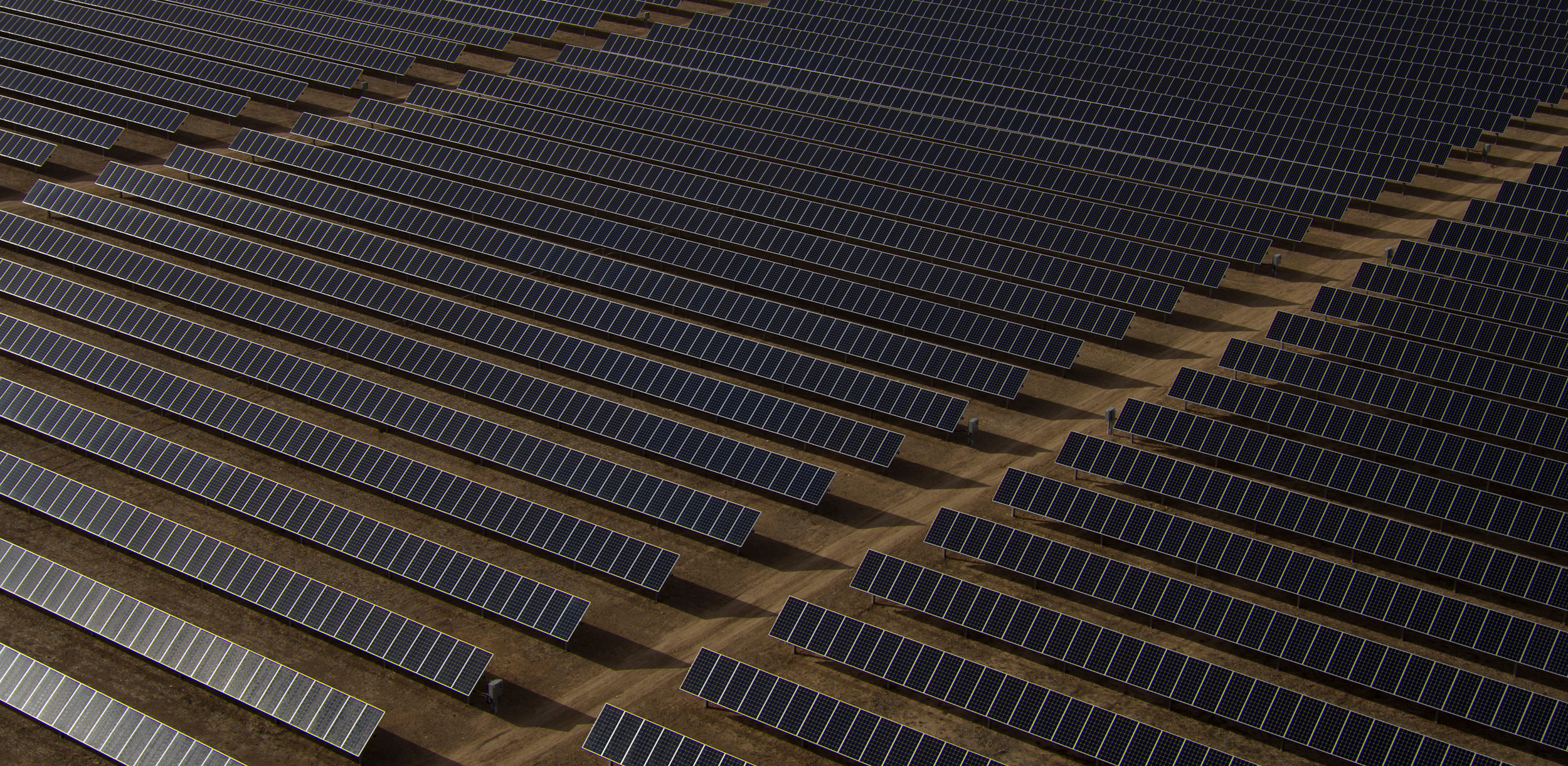
Modelling natural catastrophe risk for solar farms
Price solar risk with confidence. Underwrite with asset-level precision.
Solar is one of the fastest-growing sources of renewable energy. But traditional catastrophe models were never designed for renewable energy assets. Renew Risk delivers solar-specific catastrophe modelling, enabling more accurate pricing, improved portfolio management and stronger risk selection.
The challenge: high growth, limited data, rising losses
Solar portfolios are expanding rapidly into high-risk regions, with solar output expected to double globally in the next 5 years. Meanwhile, rapid technological advancements are making these assets more complex, and more varied from one another.
At the same time, loss experience is becoming more severe. In the US alone, 91% of existing solar farms are expected to be hit with hailstones 2 inches in size, or larger, in a 1-in-10 year return period. How will the unique characteristics of each site respond to these storms? This complexity can impact losses drastically and yet is typically missing from underwriting premiums. Collectively these hailstorms represent 6% of loss incidents, yet account for 73% of financial losses. It’s a problem the insurance industry cannot afford to ignore.
With solar on the rise, and asset values continuing to climb, this means increasing exposure in catastrophe-prone regions, with limited observational data for existing and potential solar sites.
For insurers, this creates a familiar but difficult problem: price uncertainty.

A catastrophe model built for solar assets
Renew Risk takes an asset-risk approach, providing catastrophe models designed specifically for renewable energy assets and portfolios. Traditional models treat solar farms like an extension of property risk modelling. Renew Risk models them as what they are: complex engineering systems.
The variety of engineering characteristics found on a solar farm can impact losses ± 100% or more. We explicitly capture:
Panel construction
e.g. glass thickness. Understanding the uncertainty of the PV module’s response to impact energy is key to modelling risk.
The latest event data
Our Industry Exposure Database (IED) captures essential insights including asset value distributions, total insured value, cost of repair, business interruption calculations, and more. Updated on a monthly basis to incorporate real world data at speed.
Stow logic and tracker systems
e.g. stow angle and confidence, tilt angle and axis tracking. Stowage has been shown in scientific research to be the most accurate method for mitigating hail damage to solar farms.
Site-specific vulnerability
Capturing every engineering characteristic combination in the market for a highly customised view of risk.
Interaction between perils
Hail, tornados and straight-line wind are not independent during severe convective storms (SCS). We model the relationship between these elements to calculate damage ratios.
High-resolution event footprints
Modelling perils with high frequency, low severity and hyper localised footprints requires a different approach. We provide high resolution across the model domain, without causing lengthy run times.
Introducing: Renew Risk’s US Solar Model for SCS
Storms cause billions in solar farm damage annually, yet traditional risk models fail to capture their hyper-local nature. We’re building a next-generation US Solar Model to create a paradigm shift in how hail, tornado and straight-line wind risk is understood and priced for solar farms across the US.
“As utility-scale solar adoption accelerates across the US to meet clean energy demands, the complexity and concentration of asset values are reaching unprecedented levels. Our model addresses a critical gap in analysing these specialised risks, particularly in regions most vulnerable to severe storms. By leveraging the asset first Renew Risk approach, stakeholders can drive more informed underwriting and portfolio management decisions as material loss potential continues to rise.”
A transparent modelling framework
-
A mix of historic and stochastic events across the whole model domain. But by focusing on where existing and planned solar farms are concentrated, we can shrink the focus and scale simulations by an order of magnitude of more, without causing lengthy run times or high computational costs.
-
Explicitly capturing a multitude of interrelated factors that influence the extent of damage caused by severe convective storm, including:
Hailstone size and impact energy
Wind speed and direction
Event duration.
-
Our Industry Exposure Database (IED) is a live geospatial intelligence platform built to identify, standardise, and monitor utility-scale solar assets across the US. It brings together multiple public datasets into a single structured view of existing and future solar site locations, characteristics, and exposure-relevant attributes.
Nationwide utility-scale solar asset coverage
Standardised site-level geospatial and plant information
Integrated multi-source data validation and enrichment
Output-ready formats for analytics, mapping, and risk workflows
Designed to support underwriting, portfolio analysis, and exposure management.
-
Solar farms are primarily located in remote areas, with limited observational data. Renew Risk specialist approach to vulnerability comprises:
Reviewing existing damage and claims data
Capturing site-specific vulnerability across the market’s engineering variations
Laboratory testing at the University of Surrey by Renew Risk Co-Founder Professor Suby Bhattacharya
Expert elicitation from cross-industry consultants.
-
Calculating various loss metrics for different financial perspectives including AAL, ELT, insured vs ground up losses, and more. Renew Risk can also incorporate specific event limits, deductibles and other T&Cs.
The power of partnerships
We believe the best models are built together. Renew Risk partners with leading experts across insurance, engineering and academia to create models that are asset-focused and enable risk professionals to navigate the complexities of solar farm exposure with confidence.




Read about how we’ve partnered with Vāyuh to build a next-generation US Solar Model
Built to integrate into your workflows
At Renew Risk, we want our clients to derive as much value as possible from our products, which is why onboarding and customer success are two of our key priorities.
Access our services via:
Quantify and manage the risk of catastrophic events with Renew Risk’s solar models
Get in touch to learn more.