
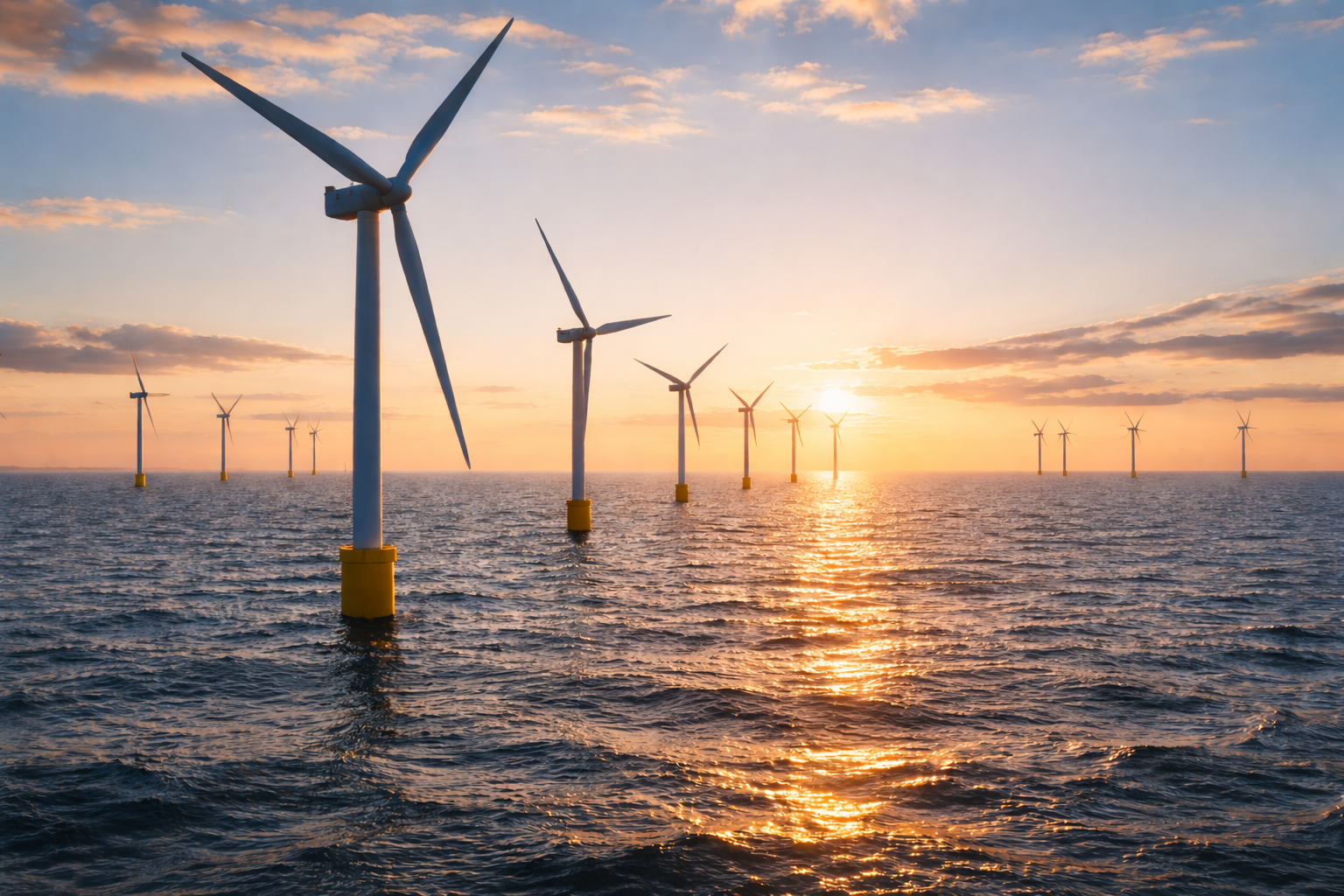
AR7: Insuring the next generation of offshore wind
Dr. Georgios Deskos
Head of Offshore Wind Products
Renew Risk
Earlier this month, the UK Government announced the contracts awarded through AR7 (Allocation Round 7), one of the most significant funding rounds to date, adding a record ~8.4GW of offshore capacity to the UK’s energy mix. For many, the go-ahead for these large-scale projects signifies confidence in the UK’s offshore wind sector and a positive momentum for the energy transition. But beyond this, the announcement also signals a new phase of technological and geographic complexity, unlocking projects in deeper waters and more exposed locations, and built using innovative technology.
The result: a new risk landscape that historical underwriting records cannot fully address.
For the insurers involved in underwriting UK projects, this is something of a new challenge. Decades of investment, supportive policy frameworks and experience have driven rapid capacity growth for offshore wind the UK, resulting in historical loss data unrivalled in many parts of the world. But looking ahead, some of the offshore wind farms to be built under AR7, like Blue Gem Wind in the Celtic Sea, are moving away from the fixed-bottom turbines and relatively sheltered locations found in the UK’s existing fleet of offshore wind farms. Instead, these new developments are likely to be built with larger turbines, with semi-submersible floaters, and located further offshore where exposure is greater due to factors like wind and wave magnitude, and a decrease in sheltering. As a result, these new offshore wind farms have limited or no operational or extreme weather history, meaning historical losses offer only a partial view of the risks to these new projects.
This is a fundamental challenge for underwriters. What risk will natural hazards such as extreme winds and storm surges pose to these new sites? How will the wind turbine components perform in these new conditions? How much of a challenge will soil erosion prove to cause for the cables? These are just some of the questions that historical risk will insufficiently answer.
A further risk arises from the perception of extreme weather. The UK’s offshore wind market has enjoyed a relatively predictable weather pattern in the past decade, resulting in low risk when it comes to extreme windstorms. However, windstorm severity and frequency is cyclical, with the previous period of high windstorm activity experienced in the 1990s – a time when only a few offshore wind farms were operating and therefore resulting in a lack of losses. As the UK (and the rest of Europe) enters into a more active windstorm phase, a new facet of risk is added to the AR7 project portfolio.
Insurers can no longer rely on history alone to guide future decisions. This is where specialist expertise becomes essential. At Renew Risk, we’re building state-of-the-art risk models for the UK and European coastlines. Using our advanced catastrophe modelling expertise and asset-first approach to building an engineering-informed analysis, we evaluate risks across the whole project lifecycle. From pre-design risk assessments for developers to pricing insurance premiums, we help build confidence in those “never been done before” situations, where uncertainty is highest and standard assumptions may no longer hold true.
“New frontiers in offshore wind are both exciting and inherently complex. Accurately quantifying risk is not trivial—it is a scientific challenge that the offshore wind development team at Renew Risk has been addressing for many years. With the European Windstorm model coming online, developers, insurers, and financiers now have access to a level of risk insight that simply did not exist before.”
AR7 represents progress and opportunity. But it also demands a shift in how risk is modelled and managed. Insurers who rely heavily on precedent risk underestimating the frequency and severity of potential future losses for this new generation of offshore wind projects. We can help.
Frequently asked questions
-
AR7 projects are moving into deeper waters, more exposed locations, and will likely be built using newer technologies such as larger turbines and semi-submersible floaters. These conditions differ from the UK’s existing offshore wind fleet, meaning historical underwriting data alone cannot fully capture future risk.
-
It is likely that the AR7 projects will use new technology such as larger turbines, semi-submersible floating foundations. The sites are also further offshore with higher wind and wave exposure. In contrast, much of the current UK fleet relies on fixed-bottom turbines in relatively sheltered locations.
-
Key hazards include extreme winds, storm surge, and wave loading, as well as soil erosion and scour that can expose or damage subsea cables over time.
-
Windstorm activity in the UK and Europe is cyclical. The last high-activity period occurred in the 1990s, when offshore wind capacity was minimal. As AR7 projects come online during a potentially more active windstorm phase, exposure to losses increases despite recent decades of lower observed risk.
-
Catastrophe modelling helps insurers and developers assess future-oriented risk. Renew Risk’s advanced models combine historical data with simulated weather scenarios to evaluate how new (and existing) offshore wind farms may perform under these conditions.
-
Managing risk to offshore wind farms requires an asset-first, engineering-informed approach, combining hazard modelling, structural performance analysis, and lifecycle risk assessment to support design decisions, insurance pricing, and investment confidence.